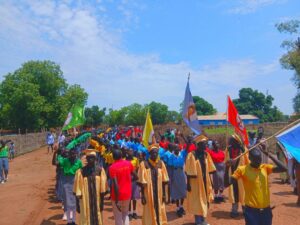
The aim of this one-year project was to teach local people, through agricultural training, how to farm their land sustainably and more efficiently. Sixty selected representatives from the individual villages of the district acquired, in three three-month cycles, knowledge of irrigation, composting, better tillage, planting and the like. In addition, agricultural courses were also introduced into the curriculum of the local primary school, and more than 300 pupils take them each year. Residents’ own farming activities were also supported by a micro-loan mechanism, a seed and seedling bank, and a system for lending machinery and tools.
Agriculture is the fundamental source of livelihood for the residents of South Sudan. Thanks to the training participants’ having taken on more effective techniques and methods, they will be less dependent on rainfall, less exposed to weather fluctuations and able to farm more efficiently. The project was an adaptation to climate change, which affects sub-Saharan Africa above all. In addition, as a consequence of half a century of civil wars in Sudan, residents lack knowledge of how to till the land and grow crops, as well as the necessary tools, quality seeds and seedlings.
The project was supported from the state budget of the Slovak Republic through the official development assistance programme SlovakAid with a contribution of €180,380.65.